

Actual π: 3.1415926535897932384
Circle
A circle is a two-dimensional shape consisting of all points in a plane that are at a constant distance from a fixed central point.
Radius
The radius of a circle is the distance from the center of the circle to any point on its boundary.
Circumference
The circumference of a circle is the distance around the boundary of the circle,
That Ratio (Pi, 𝜋)
The ratio of the circumference of a circle to its diameter is a constant known as Pi (π).
Pi is approximately equal to: 𝜋 ≈ 3.14159
How we used to calculate
Before Pi was formally defined, ancient mathematicians like Archimedes used polygons to approximate the area and circumference of a circle.
The idea was to inscribe (draw inside) or circumscribe (draw outside) a circle with polygons (like squares, triangles, or hexagons) and calculate their perimeters or areas. Circumference = Number of sides×Side lengthh
6 sides
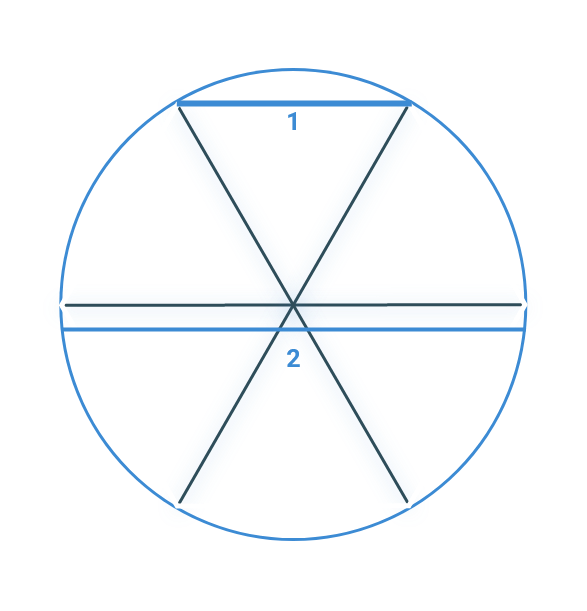
C = n of sides x side length
C = 6 x 1
C = 6
PI (𝜋) = C / R (radius)
PI (𝜋) = 6 / 2
PI (𝜋) = 3
If this were the circle, this could have been the ratio, the ratio of the circumference to its diameter.
As the number of sides of the polygon increased, the approximation of the circle became more accurate.
12 sides
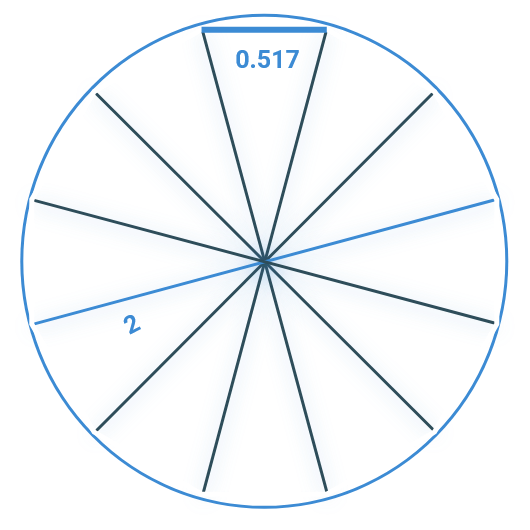
one side = 2R x Sin(𝜋/n)
one side = 0.5176380902
C = 12 x 0.5176380902
C = 6.21165708246
PI (𝜋) = C / R (radius)
PI (𝜋) = 6.21165708246 / 2
PI (𝜋) = 3.10582854123
Archimedes didn't have the precise value of π as we know it today, nor did he have access to modern trigonometric functions like sin.
Instead, he repeatedly doubled the number of sides of the polygon (e.g., 6, 12, 24, 48, 96) to get closer to the circle's shape. For each doubling, he calculated the side length of the new polygon using geometric relationships (not trigonometry).